A car alarm goes off in the distance. The reflecting lake is frozen over. With the wind it feels like seven degrees Fahrenheit outside. The sun is past its peak and the salt is no longer melting ice on the sidewalks, parking lots, or road. Donald Trump was just sworn in as president, again.
His talking points are sharp – honed by genocidal masterminds dictating his every move. His wife, dressed to the nines during the handover he refused to participate in during his first term, stands ready to bang the tambourine, somehow joylessly. He appears to be on Ozempic just like the rest of America – trimmed out like a show steer in receipt of the best healthcare on planet earth. His MAGA acolytes are sated, standing by for orders and endless disappointment.
My earliest memories of this uncle are of him casting a fishing net into the pond behind his house. He, unlike almost every other adult I came across in Bangladesh, did not pay special attention to or spoil me.
He is purposeful and speaks infrequently.
Once, when I wouldn’t leave him alone because all I wanted to do was go net fishing, he took me on an adventure to get bait. I probably didn’t shut up, but he never showed annoyance. He just smiled. I enjoyed mimicking his behavior. He didn’t tell me where he was getting bait from in response to my incessant questioning – he showed me. He climbed up a tall betel nut tree with absolutely no difficulty, and returned with part of a fire ant nest full of larvae.
This is my oldest uncle. He’s actually the husband of my aunt, but I like him better, and in Bangla, you don’t make the differentiation in words anyway. You refer to them as you would blood. Uncle. “Foofa.” Paternal. As long as I’ve remembered him, his beard has been white. He’s thin, tall, and handsome.
He picked out the larvae while getting bit numerous times. He didn’t flinch. He explained that sometimes, we have to inconvenience animals for our own gain, but that we should be careful and gentle. He also said that he only took a piece of the nest because the ants would rebuild, just like with honey and bees. For years after that, my uncle was more myth than reality in my mind.
During my most recent visit, I was reminded emphatically that this man is a treasure. He doesn’t kill mosquitoes because “they have to eat too.” I can’t begin to explain the things he’s endured in his life. This man is the closest thing to a saint that I can point to.
There is a gulf between here and there – of language, culture, familiarity. As someone who was conceived in Bangladesh and born in America, I live with a deep grief of knowing that I do not know what I do not know. I have not had the good fortune to spend meaningful time as an adult with people that mean a lot to me.
He’s ill currently. He’s old. If you’ve read this far, I ask that you pray for him.
There’s a colloquialism in Bangla that I both may not have fully understood, and will not accurately relay.
“One does not stand under a ringing bell twice.”
A little more than halfway into the train ride, my cousin asked if I would consider taking a train again in Bangladesh. I couldn’t even laugh – I just said no.
Years ago, complaining that my father never took her anywhere, my mother told me that she’d once ridden a train in Bangladesh as a small child, and then never again. That stuck with me. She’s never even ridden a train in the US. Furthermore, she’s never gone sight seeing in Bangladesh – not once. Not once! Granted, she left Bangladesh around age 20, but still – she’s been back to visit at least 15 times since then, and it’s always been to our hometown and accompanying villages.
So when I told her I wanted to go to Sylhet with her, she acquiesced. My dad has no such desire to travel because he’s a pill. Turns out the pill has good points, but we’ll get to that. Traveling in Bangladesh without a Y chromosome is rough, to put it lightly. Bathrooms, stares, respect, and existing comfortably in a sea of men (there are very few women in public spaces) – if you can imagine, and you should try, none of this is easy or simple. I knew we had to commission a male cousin. I told the youngest, just married, cousin that we needed the help, and that his wife should come too. I also yanked a female cousin away from her husband and two kids for kicks. So, we were a party of five. Only my male cousin had ever been on a train. He tried to tell us what to expect.
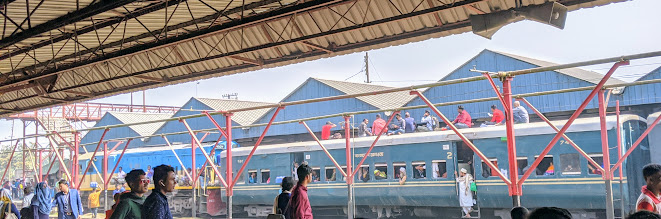
Naturally, it was late. The trains in Bangladesh are not fast. And naturally, out of nervousness, I asked that we get to the station early. We got there 45 minutes early for a train that was an hour late. One horrifying bathroom, cup of train station tea, and ample wandering later, the train was about to pull up. He told us not to rush on – that everyone would rush on – and that it wasn’t necessary because we had reserved seats. This makes sense, but for some reason we still got caught in the wave, crushing each other to quickly get on to the train that was late and slow. Why is there such a rush to get on?
They oversell the seats. They sell more tickets than seats. This is why you see people on top of trains in Bangladesh. The ticket vendor offers you a discounted ticket and pockets the money. Official seats must be bought through an app, and they sell out fast. People still have to get places. So, they oversell the seats.
So we nervously, quickly, found our seats in the crush of people. In the milieu, one lady had her gold necklace grabbed right off her neck by a thief. Apparently such thievery is less now than it used to be, but obviously, it’s still around. She caused a scene for just a couple of minutes. Efficient. I already knew to keep my phone tucked carefully away, and that if I held it out or up, to stay vigilant. A mother with her young daughter asked if her daughter could sit on the ground between me and my mother’s legs. I gave her orange slices instead. Playing the game of keeping your heart protected while observing sadness just inches from you – visits to Bangladesh have taught me how to do that to a level of proficiency, not excellence.
When I decided on a train, I thought a pro would be that we could wander the aisles and stretch our legs a bit. Wrong. Oversold train means packed aisles and floors. Standing room only. And ours was a “less crowded” train, according to my cousin. We were lucky. So I settled into my seat for the longest ride. Ours was the very last stop.
Another pro, I had thought, was that given it was wintertime in Bangladesh, the weather would be pleasant and an AC car would be unnecessary. This is mostly true, and largely moot. This particular train didn’t even have an AC car. The weather *was* nice. Winter weather in Bangladesh is pleasant – it’s warm, but not hot, sunny – perfect for windows open, in theory. The issue is the dust. In many places, especially where there are literal sand/dust fields (they collect it for construction), a train with open windows is a recipe for dust inhalation on a scale maybe only bedouins are familiar with. By hour three, we were covered in a layer of gray dust visible on my blue hijab.
Finally, the beggars. Yes I’m quite familiar with the level of beggary in Bangladesh; this unfortunately no longer shocks me. But trains offer a veritable circus show of beggary. The show plays on loop. There are the limbless ones. There are the angry religious ones who throw pamphlets at you (they grab them back). There are the sweet religious ones who sing rhyming songs to tempt you into giving. There are the more plain tongued, maybe religious but probably not ones, who simply mumble about God and Islam and make you feel quite guilty, whether you gave or you didn’t. There are the blind who very much want you to know how blind they are.
Then there are the transgender women. They have the most unique tactic of all. They threaten to strip unless given money. My cousin had explained them briefly to us – the government does nothing for them and their families throw them out, so they are forced into an organized form of beggary. We had previously appointed my male cousin as the point of contact for all the beggars – not giving money was not an option, and he could decide how much and to whom. The transgender women board together and immediately start getting in people’s faces. They are quite organized. One briefly got in my face, and my mother pointed her to my cousin. In that ultra brief moment, I could tell she wasn’t angry at all, and she certainly wasn’t mean. This front of threatening and sass was just that – a front. This was the only way they could figure on how to piece together a living. What a world.
I had no desire to contract diarrhea from the train, or to munch on dusty things, so I passed on most snacks. Six hours wasn’t forever, not by a long shot. When six hours turned to eight is when the walking vendors holding puffed rice that they’d toss with spices and cilantro and lime started to look like better options. Eight hours finally turned to nine and this is when the aisles were finally open enough to walk down. I grabbed my female cousin to go see the food car. The food car was just a normal car with a tiny bar from whence the walking vendors were emanating from. It was like the place in video games where villains spawn from. I was in quiet hysterics by the time we de-boarded and threw my misery at my mother as soon as we got to our hotel rooms.
No, you don’t stand under a ringing bell more than once.
I re-worded that sentence because I’m not a constitutional scholar. I’m not a scholar at all. In fact, I have very few skills overall, but one of them is getting the gist of a situation quickly. Also Tetris.
I don’t wish disease upon him, or any ill will at all actually. This is largely because the next in line would result in real life Handmaid’s Tale, and the next next in line could easily be a President Alma Coin situation.
Once upon a time, pre-November 2016, I was criticized by a very woke white man for saying that I thought the President’s office played out a lot like the show Veep. That the show was entirely too ridiculous and that real life doesn’t work that way.
No, white man. Real life is the landscape a painter tries to capture on a canvas. Pop culture is the machine by which America tries to process its reality.
As our current President continues to hide under his desk with a bottle of hand sanitizer and precious brain cells to spare, he too is trying to anticipate the future. He thinks his is a valiant effort to save America, but his thoughts as a leader are clouded by his fear of death. On the one hand, he could get infected and fight it off and come out like a hero on the other side. On the other, he could die, leaving stupid Pence the job, and the Democrats a takeover come November. Oh, God, he should call the lawyer to revise his will. No, the best course of action is to stay in a bubble, stay healthy, do whatever the cabinet advises, and obviously postpone the election. The economy won’t bounce back fast enough to get re-elected in November. Bet ya Biden’ll kick the can faster than me. Man, I could really go for a Big Mac right now.
The DC metropolitan region is experiencing an off kilter moment. Typically, this place is like so many suburban hellscapes across America – bland, cul-de-sac’d, and self absorbed. This is not a place used to system-wide doubt.
Suddenly we’re zoomed out in our collective mind’s eye and feeling like the one human body that we are actually a part of, where a microscopic and faultless entity threatens the whole system.
When I’ve taken a walk around the block recently and had smiles beamed back at me, I imagine it is because people are for once thinking and feeling. Worrying, fearing, but also awakening. Moments of deep uncertainty give us that nervous but real smile when we meet strangers. Lean in. Why not? This smile is directly connected to our nature as humans: to seek connection, help. To acknowledge each other kindly.
This head space – the chair tilt backwards where you will either fall or right yourself again – this is where philosophers do too much and laypeople too little. I’m wondering how this might go and I’m thinking it’s to good things (my imagination tells me so), though I think it will be through a maze of bad things (my imagination also tells me this).
I once fell backwards off an elevated stage, seated in a folding chair, in front of a crowd and live TV cameras. It was about four feet down. When I landed, I took a breath in and asked myself if anything was broken. No. I stayed down an extra moment rather than stumbling upwards. In this moment, two people jumped to assist me. The first ensured I was upright and unbroken. The other gracefully extended her hand as I stepped back up on stage.
May Allah allow us to channel our deepest kindnesses to each other as we fall, and let that be the conduit for finding our balance again.
Something about the arrival of a global pandemic is changing the fabric of our communities.
I’m used to being the lady in grocery stores and gas stations who smiles and starts up a brief conversation with you for no good reason. I say hi, I comment on the weather, I bring up an interesting topic ever so briefly, and then I peace out and try to let you be on your way within a couple of minutes.
You do one of a few things:
Nervously participate and try to escape quickly
Reciprocate too hard and get weird
Participate halfheartedly (most frequent)
The point is that I don’t get much reciprocity in these streets.
This past week, I’m getting record returns. I’ve never had so many genuine smiles mirrored back. Everyone is amped-up and paying attention to feelings.
I hope we quickly gain the tools and stances necessary to treat this new virus and any future viruses effectively, but I sure hope we keep this public kindness. Please and thank you.
My recent trip to Bangladesh was perhaps the most impactful of my life. I landed in a 2020 Dhaka which was nothing and everything like the Dhaka of my childhood.
Childhood trips had involved a one- or two- night stay in a mosquito/roach-frequented hotel, followed by a very bumpy bus or car ride 6-10 hours south to our hometown. My dad wasn’t really the kind of guy to spend on a western-style hotel or an overpriced ride to rural Bangladesh.
This trip, in my thirties, equipped with an incorrigible nature and a smartphone, I would do things I directed myself. My parents followed their typical routine and headed south, failing to convince me to do the same. I stayed back in Dhaka for a week, solo.
Solo. Female. American born. This raised so many eyebrows around me that I wondered if I had spinach in my teeth. Sure, women now do everything in Dhaka. Rich women. White women. Chalak* Bangladeshi women. Just not American born Bangladeshi women with roots in Noakhali who can’t read, write, or properly speak Bangla.
I cannot begin to describe Dhaka adequately in one post, so I won’t. Yet.
I will only say that I figured out how to get around. The answer for me was mostly Uber, and my start and stop point was the American Burger pictured above. You must take into account that almost no one I knew thought it possible that *I* would be taking Ubers around town by myself. Most of the drivers don’t seem to know how to use their phones, exactly. I imagine many cannot read. But the ones in my neighborhood all knew where the American Burger was, thank God.
I started to feel like what an American Burger must feel like. A little foreign but not completely foreign, palatable in conversation, conditionally portable, honestly pleasant overall. See American Burger walk. See American Burger run. See American Burger try to cross one of Dhaka’s highways on foot without being turned into burger meat.
Have you ever gotten a brilliant thought, then forgotten what it was? You know you had thought a brilliant thought, but you can’t recall what that thought was.
It happens to me while driving, walking, and dreaming. I’ve heard it happens to people in the shower.
Of course, sometimes I try to capture these thoughts. I keep sticky notes and a pen in the car, and still after that left turn or lane merge it can dissipate. I repeat sing-song chants in my head while walking to remember the thing, and just saying ‘hello’ to a passersby can zap it. There is usually a notepad next to my bed, but the simple act of fluttering my eyes open can ruin the subconscious stream.
Where do they all go? They can’t just disappear. They’re knocking around in there somewhere. My current batting average for capture is intensely low. I can’t help but hope that, by summoning my inner Sisyphus, maybe I will have a truly Brilliant Thought one day.
Title: Ma-ch. Mach. Mach D-oh-pya-ju. Mach dopyaju. Fish with onions. Twice cooked fish with onion.
She is halfway done with the fish dish preparation and hasn’t said a word to me about what went in and how and why. “I’ll tell you, don’t worry.”
6 fish steaks, cut in half, ½ a large fish, “Mirigal” Mach (Carp?)
1 tsp Cumin ½ tsp Turmeric ½ tsp Cayenne 1 tsp Salt 1 tsp Ginger/garlic paste
2 large red onions, sliced thin 2 medium tomatoes, sliced into thin wedges
Marinate the fish steaks in the cumin, turmeric, salt, and ginger/garlic paste mixture for 5-30 minutes (30 minutes is ideal). They should not be sopping wet but rather damp from the mixture. Fish marinates quickly. Heat a pan large enough to hold all the steaks to medium-high heat. Saute the steaks in a tablespoon of any neutral vegetable oil (canola is fine) for a few minutes on each side until they are cooked through.
We just learned that the guests arriving in three hours are not, in fact, Bangladeshi. They’re Hyderabadi. Amu and Abu are in a very mild argument over this fact. She thought they were Bangali and that they would eat fish. He assures her they will.
Your kitchen should be overwhelmed with scents already, since you were practically dry frying fish with spices. I am coughing. Set the fish steaks aside. Add another tablespoon of oil to the pan, and all of the chopped onion. Add salt to taste – about a teaspoon. Saute a few minutes until the edges are lightly brown. Cover if they’re cooking too fast, uncover again to stir – so on and so forth. Once the edges are lightly browned, add the tomatoes. Saute for a couple more minutes to heat the tomatoes.
½ tsp Cayenne ½ tsp Turmeric
Add another ½ tsp cayenne and ½ tsp turmeric. Saute another couple minutes to bloom the flavors of the newly added spices. Add about ½ cup water. She said I didn’t have to add this part, but she added a couple of teaspoons of sugar – this may not be necessary if your onions have enough time to caramelize. She is rushing and wanting to please guests who may not enjoy fish. Add the fish back in, gently so the pieces don’t break. Cover the dish, turn the heat down to medium, and let cook for about five minutes.
1 large wedge lime ¼ cup chopped fresh cilantro
Your dish is bubbling away. After it’s cooked for about the five minutes above, squeeze in the lime, sprinkle the chopped cilantro over top and cover again to let it continue cooking. You want some reduction of the water. Taste and adjust salt as needed. Two more minutes and you’re done.
The bus station in Harar is a swirling mass of silver fish – dizzying to the alien finding herself in an ocean. Cars, bajaj, donkeys, and buses do not stop, even as people mount and dismount them. I am assisted into my minibus – front seat to accommodate my foreign-ness. This bus will take me back to the airport after a week spent in the city.
Harar is dust and petrol in winter. The dust obscures the region’s rich history. Harar was once a great trading post of intellectualism. Now it is just under construction. For what, I do not know.
There is diversity here. Some Muslims drink, some Christians are strict in dress. There are hijab-ed women in shin- and knee-length skirts. Tight pants. Abayas. Burqas. Mostly colorful, plenty of prints. These people are not cosmopolitan enough to care about what you are wearing.
This place is too much like Bangladesh for me to look away. The yelling goat sounds like a crying baby. The women carrying sundry on their heads sway to keep balance that American suburban yoga soccer moms could never have. The men hold hands. The crazy ch’at street addicts are like the goats – just witted enough to get out of the way of oncoming traffic. Construction is concrete, bamboo, and iron rods. The seatbelts don’t work – on purpose. The people are thin from built-in exercise and a moderate diet. The animals could be treated better.
The military and police are haughty. I’m unsure of their motivations – why they stop people, and why I saw them escorting a group of 20- or so people- some handcuffed.
The drivers treat their buses, trucks, and vans like race cars on the highway mountain switchbacks, oncoming traffic doing the same. Weaving, speeding – it’s a terrible combination and I shudder at the kinds of accidents that occur.
The driver’s assistant just tried to raise the price on me, mid-drive. My suddenly stony face (this is a skill) deterred further pestering. I do not like having to use this face. Like I said – this place is too much like Bangladesh. I wander around both places amazed, in love, with a hard RBF.




 ভাঙ্গা Bangla